

Body of Knowledge: What Women Actually Think About Cycle Syncing
Body of Knowledge is Soulstice's three-part series on cycle syncing — mapping the current landscape, digging into the debate, and redefining what it means to live by your own rhythms. This is part two. Read part one here.
Is cycle syncing empowering or just another set of rules to follow? We talked to real women about what cycle syncing actually feels like from the inside — and explore what it looks like when it's truly yours.
Picture this: you’re scrolling and come across a post on what foods to eat during each phase of your cycle. You make a note for your next grocery run. A few minutes later, you see a post all about why you should jump rope and lift heavy while ovulating and do pilates during your luteal phase. So you reschedule your gym session until after your period. A little further down you see a video saying you shouldn’t make big decisions during your luteal phase. But you’re currently in your luteal phase, and are running out of time to make up your mind about something major. You start to spiral. And then you see a hot take about how cycle syncing is all just disempowering pseudoscience. But, you’ve experienced the ebbs and flows of your different phases. Suddenly, what began as a way to connect with your body has started to feel a lot more like stress than self care.
One of the key debates about cycle syncing is whether it is empowering or restrictive. On one side is the idea that it's liberating to put the rhythms of female physiology front and center in a society that is quite literally built for men. On the other, the belief that doing so is distinctly anti-feminist in that it reduces women to their biology and forces them to live by an externally-imposed set of rules. But what if the truth lies somewhere beyond this binary completely?
I wanted to get past the discourse and into the lived experience. So I asked around.
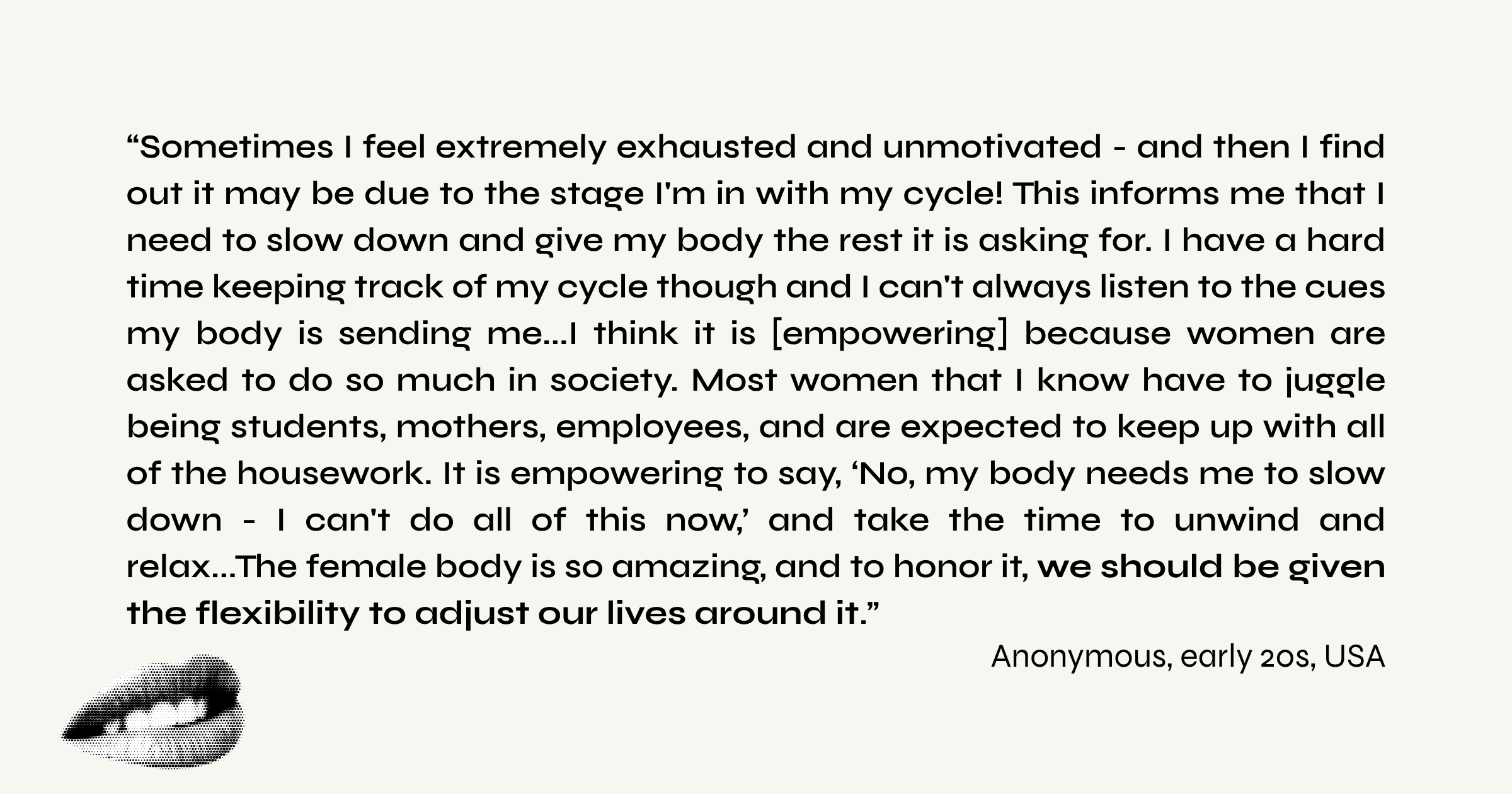
Many of those I interviewed did find it empowering. One woman, in her mid-twenties and based in Honolulu, summed up her thoughts this way: “cycle syncing is very empowering for women because it teaches us that it's okay to trust our bodies and respect their natural flows of energy and intuition. We are too often expected to ignore our intuition and hustle along, so this is permission to let go and lean inward.”
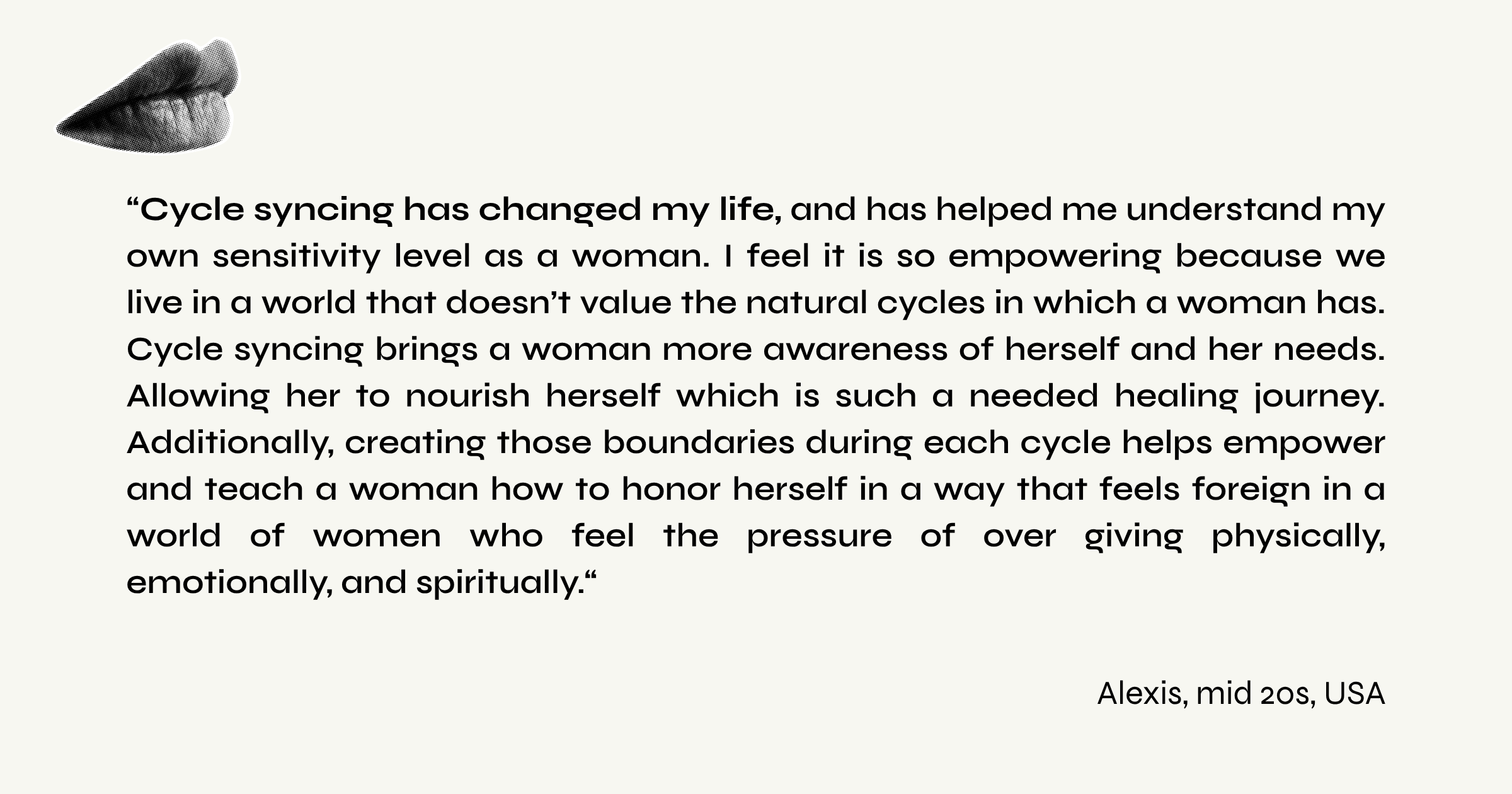
Alexis, also in her mid-twenties, expressed a similar sentiment, saying “I feel it is so empowering because we live in a world that doesn’t value the natural cycles which a woman has. Cycle syncing brings a woman more awareness of herself and her needs. Allowing her to nourish herself which is such a needed healing journey. Creating those boundaries during each cycle helps empower and teach a woman how to honor herself in a way that feels foreign in a world of women who feel the pressure of over giving.”
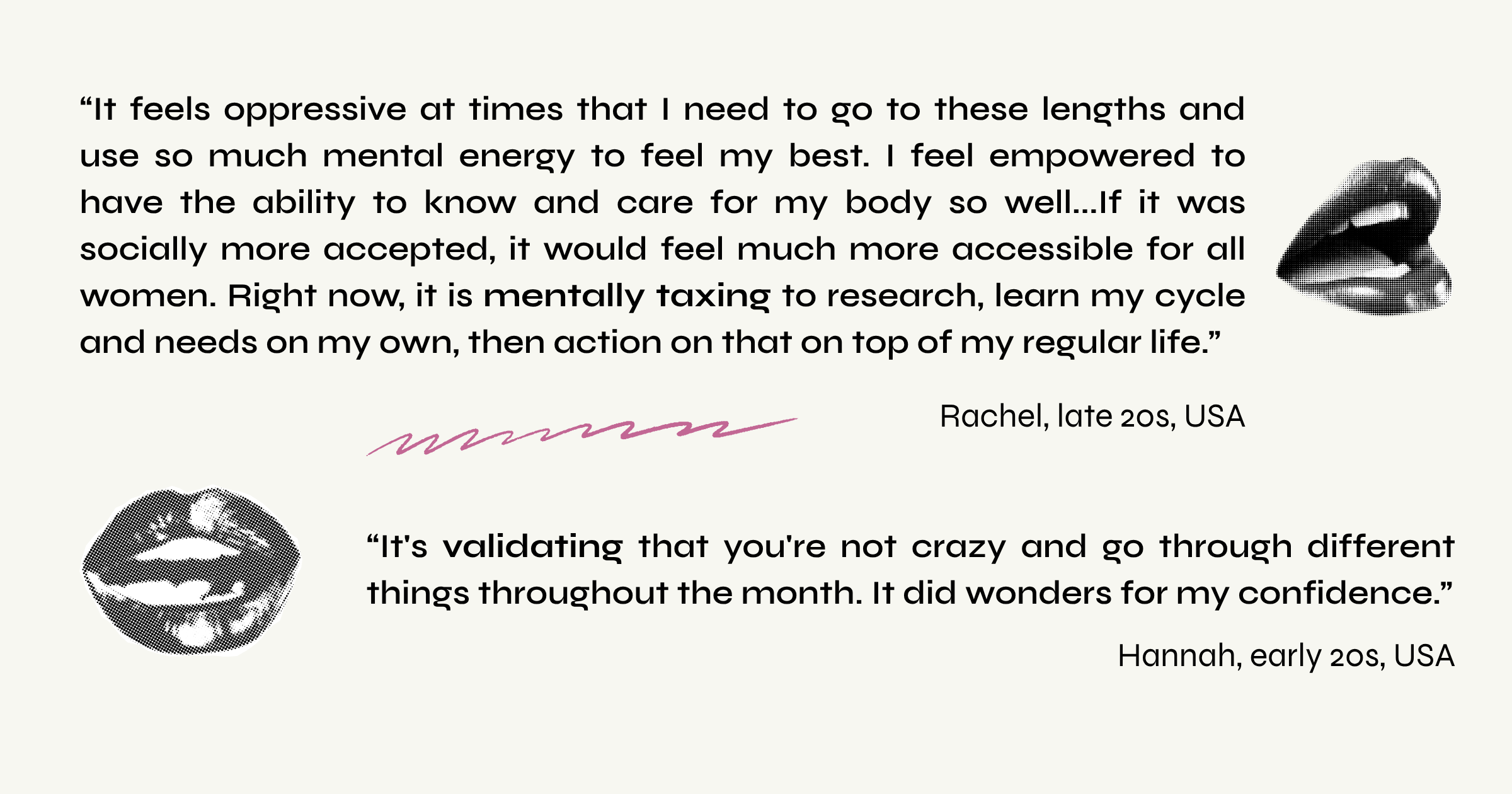
Several of the women I spoke to said that it’s helpful because it gives a voice to something they experience internally every month — and in doing so, validates and normalizes those emotional shifts. It provides a framework for why behind them. Hannah, in her early twenties and based in the Southeastern US, told me that “it’s validating that you're not crazy and go through different things throughout the month. It did wonders for my confidence.”
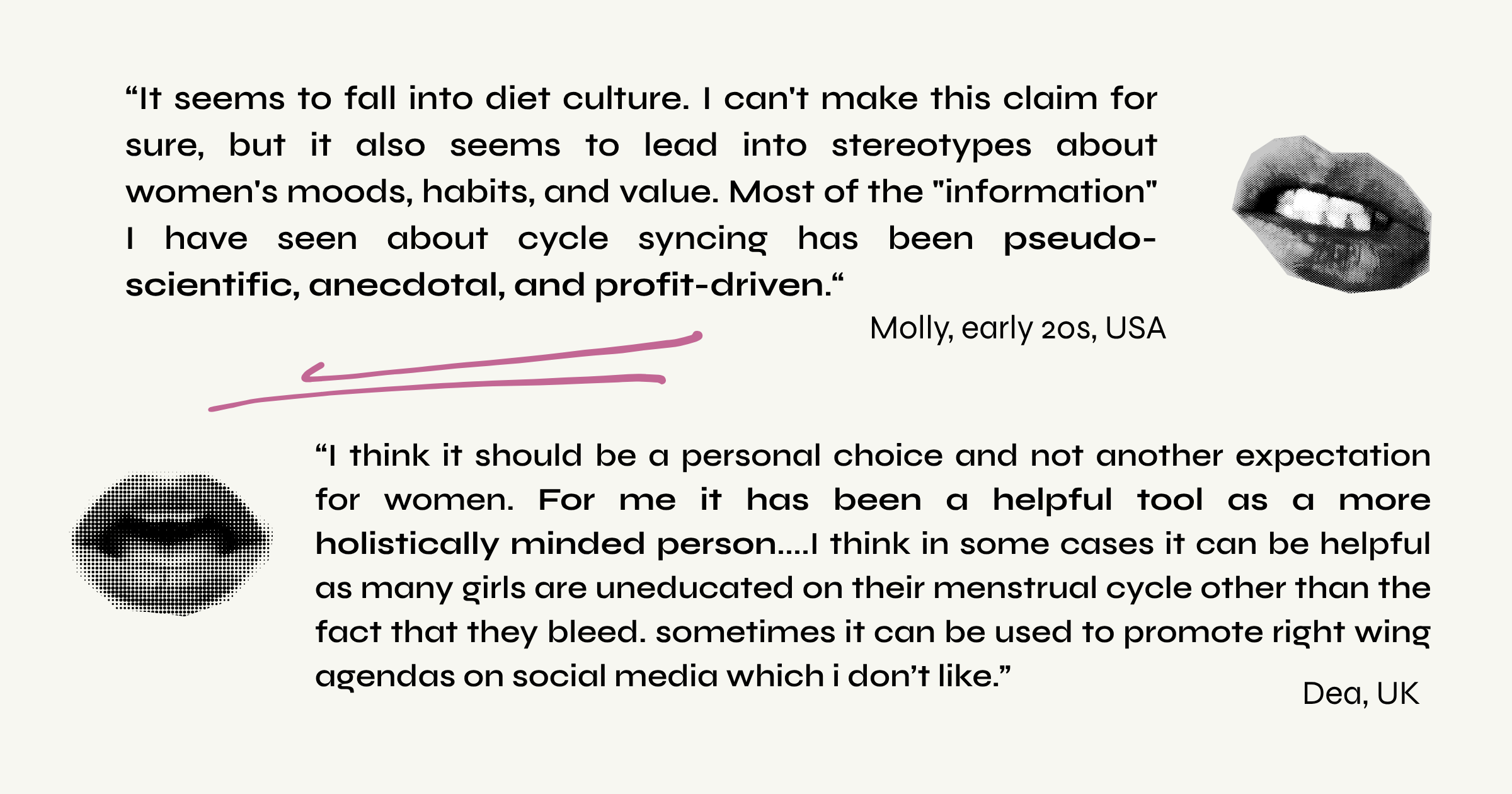
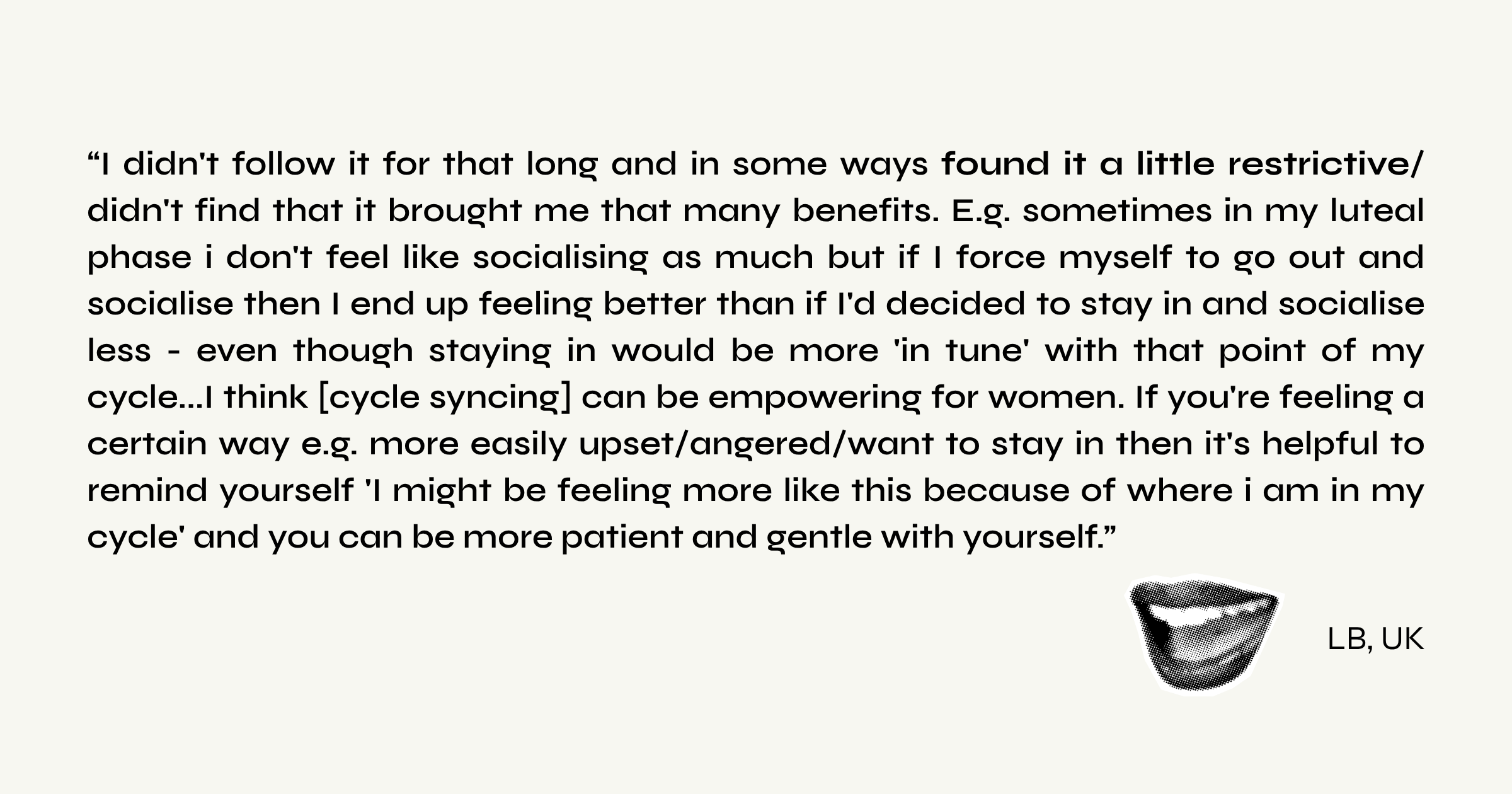
Others expressed caveats. As Dea from the UK told me, “I think it should be a personal choice and not another expectation for women.” LB, also from the UK, told me that she tried it but didn't stick with it for that long, in part because she found it “a little restrictive.” She went on to say, “sometimes in my luteal phase I don't feel like socialising as much but if I force myself to go out and socialise I end up feeling better than if I'd decided to stay in — even though staying in would be more 'in tune' with that point of my cycle.”
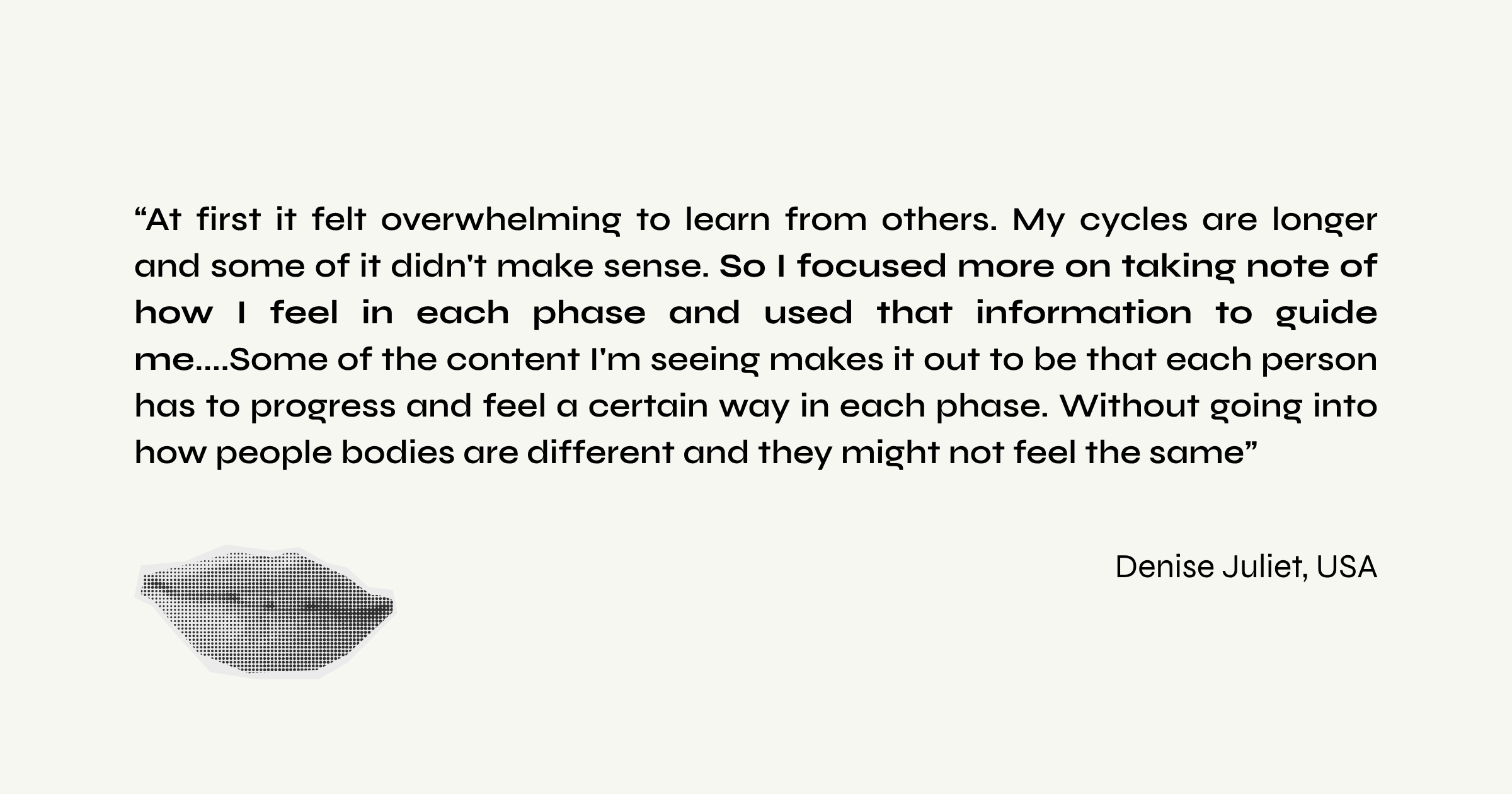
There’s also the fact that a lot of cycle syncing content assumes that the viewer has a regular, 28-day long cycle. In reality, that’s only true for around 13% of women. For the vast majority of women, their own phases don’t map neatly onto an infographic. As Denise Juliet put it, “At first it felt overwhelming to learn from others. My cycles are longer and some of it didn't make sense. So I focused more on taking note of how I feel in each phase and used that information to guide me.”
Another woman, in her early twenties from Canada, told me “I feel they often basically tell women she has 'one good week a month' and the rest is a downhill slope leading to her period. I think it is valuable to listen to your own body, not what people on the internet say. I have seen a lot that have discouraged weight training during your period, and often the week leading up to it, as you 'will feel more tired/intensity will be harmful' and I think anything that discourages women from weight training is harmful.”
Here’s where something really important emerges: when we talk about cycle syncing, we’re not always talking about the same thing. Some of the women (the majority of those who found it empowering) defined it as the practice of living according to one’s own internal rhythms. Others (who on the whole were more likely to describe it as limiting or restrictive) defined it more along the lines of following specific parameters during specific phases.
This is why there is so much pushback on those “eat this in your follicular phase” and “go on dates in your ovulation phase” infographics. Not everything is applicable to everyone all the time. It’s nuanced. And at a certain point it’s just more to-do’s adding to the noise. When reduced to a set of lists and rules, it can become another way for women to feel inadequate if their unique rhythms don’t match up to what someone is telling you that you should feel.
In other words, it’s not that cycle syncing is either empowering or limiting. Both of these things can be true at once, depending on context — that cyclical awareness is genuinely empowering, and the way it gets packaged and sold can reinforce the very pathologization it's trying to counter.
When women’s cyclicality is reduced to a formula to follow, or a list of foods to eat each week, or what you should and shouldn’t do on any given day, something vital is lost. This formulaic, reductive approach also obscures the deeper point: that cycle syncing is about getting to know your own unique rhythms though experiencing them in your own body, not about a prescriptive external source giving you a new set of rules to follow.
This reductive approach isn’t just driven by social trends — it’s also being reinforced by capitalism. As women’s health in has gotten more attention, it has been co-optation by corporations and a swath of new, largely white-male led femtech. Cycle tracking apps and AI-enabled algorithms that claim to know your body even better than you do, but really just keep women reliant on external validation while making tech bros and VC firms more money.
Molly from Brooklyn also spoke to this, telling me “I can't make this claim for sure, but it also seems to lead into stereotypes about women's moods, habits, and value. Most of the ‘information’ I have seen about cycle syncing has been pseudo-scientific, anecdotal, and profit-driven.” This is what a lot of the pushback on cycle syncing within feminist spaces is tapping into — the idea that it creates a structure to label women as hysterical, erratic, chaotic, hormonal. That rather than being empowering, those “I can’t be held responsible for what I said during my luteal phase” memes are actually reinforcing the idea that women are out of control. We’re going to dig deeper into this idea in part three, but for now I’ll say that this again highlights the importance of reclaiming true cyclical awareness and rejecting prescriptive, one-size-fits-all rules.
And it goes deeper, into the ideologies and worldviews that shape our societies.
Because cyclicality can only be weaponized in a system where linearity is the default, where industry and productivity and the bottom line are lauded above all else. And the so-called “chaos” of hormonal shifts can only be seen as a negative when women’s health is dismissed, underfunded, or flat out ignored. Because when women are equipped with the knowledge, the tools, and the space to work with our cycles, rather than be caged within them, it can only lead to greater autonomy and wellbeing.
So the question is not whether cycle syncing is empowering or restrictive, as the answer depends entirely on whose framework you're operating from. The more interesting question, and the one worth sitting with, is this: what does cyclical awareness look like at its most empowering? What does it look like when it's truly ours?