

Body of Knowledge: Cycle Syncing Has a Pipeline Problem
Body of Knowledge is Soulstice's three-part series on cycle syncing — mapping the current landscape, digging into the debate, and redefining what it means to live by your own rhythms. This is part one.

Cycle syncing has never been more visible — or more contested. Some embrace it as feminist reclamation, while others are calling it an alt-right pipeline. We mapped the ideological landscape of cycle syncing content, because the truth is messier, more interesting, and more urgent than the conversation suggests.
There’s something curious going on with cycle syncing.
At the same time that “luteal phase” is entering the public lexicon and jokes about ovulation making women feral are going viral, the practice of cycle syncing is being dismissed by many as an alt-right pseudoscience.
A recent post on threads captured this sentiment: "I can't explain how but the obsession with menstrual phases (do this workout during your literal [sic] phase! Eat differently during different parts of your cycle etc) seems like covert misogyny." It got quite significant engagement, with one user replying, “It’s vaguely anti birth control maga crunchy adjacent.” And it’s not just social media. It’s the mainstream media, too, with one recent piece arguing that cycle awareness risks teaching women they are "naturally erratic.”
All this attention comes as cycle syncing has never been more popular, or more visible. If you’re not familiar, it’s the practice of aligning your life with the phases of your menstrual cycle. It gained momentum in the 2010s — a decade that was, in many ways, a turning point for how we talk about periods — through books like Alisa Vitti's WomanCode, the broader wellness boom, and a growing movement for menstrual destigmatization. Over the last few years, it has exploded, largely thanks to instagram and tiktok. Now, the luteal phase has nearly gone mainstream — and so has the debate about what it means.
The Landscape
To the outsider looking in, it could seem like all this talk about living by your menstrual cycle is a recent trend.
But this is not a new conversation. For decades, a tradition of feminist, pro-choice practitioners have been building rigorous frameworks around cycle awareness rooted in bodily autonomy and women's health advocacy.
Second wave feminists and the women's health movements of the '70s and onwards — notably the Boston Women's Health Book Collective, who published Our Bodies, Ourselves in 1973 — championed cycle tracking as a way of liberating oneself from the medical establishment, and of becoming more deeply connected to one's body.
Go deeper: Listen to Chaos & Control
Then there was Toni Weschler, whose foundational work on fertility awareness methodology predates the wellness industrial complex by decades; reproductive health advocate Laura Wershler, who has spent years naming and resisting the right-wing co-optation of this very knowledge; integrative physician Dr. Aviva Romm, whose clinical practice sits at the intersection of evidence-based medicine and feminist care; Lisa Hendricks-Jack, whose Fertility Friday podcast has spent over a decade making evidence-based cycle education accessible to everyday women; and Maisie Hill, whose work has brought cycle literacy to a mainstream audience without stripping out the politics.
To dismiss cycle awareness as MAGA-adjacent pseudoscience is to erase them entirely. And yet, to many, that's exactly what cycle syncing has become synonymous with.
In truth, the landscape of cycle syncing is vast and ideologically diverse, far more so than its critics acknowledge. The knowledge itself — the basic facts about female physiology, hormonal fluctuations, and their effects on everything from mood to energy levels — is simply a tool. And like any tool, it can be wielded in many different ways, toward many different ends, depending entirely on the beliefs and politics of whoever is holding it.
To map this landscape, we developed a typology of cycle syncing content plotted across two axes: from left to far right, and from spiritual to secular.
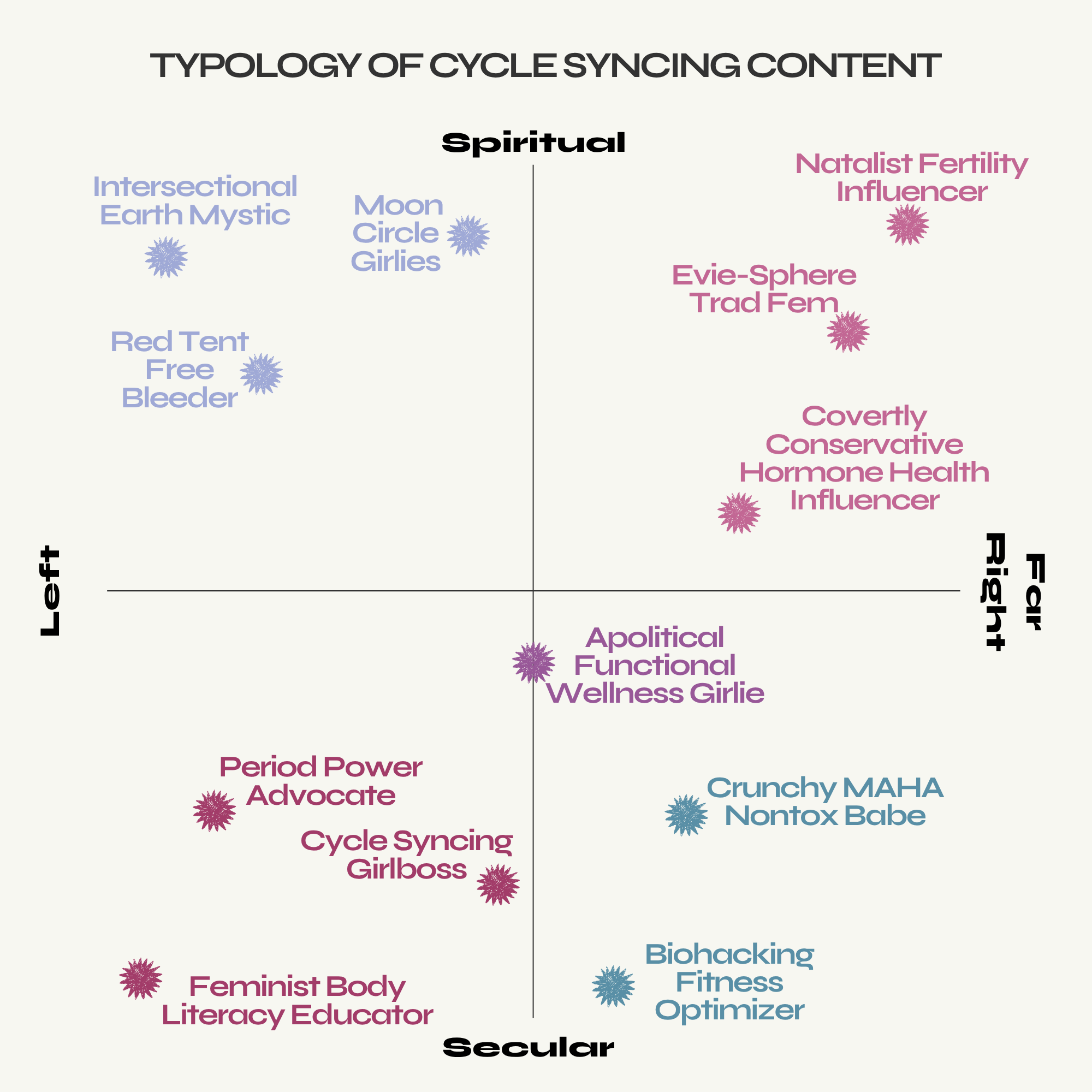
The left side of the chart is where the aforementioned tradition of body literacy lives. The 📢 Feminist Body Literacy Educator is the most explicitly political and research-grounded voice in the space. She’s in the lineage of Our Bodies, Ourselves, Toni Weschler, reproductive justice advocacy, and critical menstrual studies. She understands cycle education as a feminist and political act, a rebellion against a misogynistic medical system. She’s one of the least likely to use spiritual language and the most likely to cite peer-reviewed research and name systemic failures in women's healthcare. She knows how to self-insert a speculum and where to get abortion pills.
In that same vein is the 🔮 Period Power Advocate, who wants to make cycle knowledge mainstream and reclaim menstruation from shame. Think Maisie Hill’s Period Power. She’s evidence-informed and somewhat politically engaged, but she leads with empowerment rather than calling for straight up systemic change. She’s most likely to say “can you believe all these studies have only been done on men?” or “we need male birth control.” Thinks the medical establishment has failed women and that cycle knowledge is a corrective to that, but doesn’t go much deeper than that.
Finally in that quadrant we have the 💁♀️ Cycle Syncing Productivity Girlboss. She’s largely apolitical but uses language of women’s empowerment (think “This Is My Fight Song” and “You’re Gonna Hear Me Roar”). She uses cycle syncing language to optimize creative output, business launches, and personal performance. She may identify as feminist, but operates within a neoliberal framework with the cycle as a tool for individual achievement rather than collective liberation. Will cite hormonal research but strip out the political and spiritual dimensions entirely.
Also on the left, but further into the spiritual, we have the 🌍 Intersectional Earth Mystic, who grounds cycle wisdom explicitly in anticolonial and anticapitalist politics. Her spirituality is inseparable from her political analysis, and she understands the body as a site of both personal and collective liberation. She’s most likely to center indigenous and non-Western frameworks (rather than vague or new-age spirituality), name whiteness in wellness culture, and connect menstrual health to broader systems of oppression. She sees the menstrual cycle as part of larger understanding on nature’s cycles.
In that same quadrant, we have the🩸 Red Tent Free Bleeder, who traces her lineage to second wave feminist spirituality and the conscious reclamation of menstruation as sacred and collective. You’ll find her hosting women’s circles, honoring her menstrual blood, and approaching her cycle as ritual rather than a private medical matter. She’s likely to repeat quotes like “menstruation is the only blood that is not born from violence, yet it's the one that disgusts you the most." Her politics are embedded in the practice itself and most often not named explicitly.
Then there’s the 🌙 Moon Circle Girlie, who shares the above aesthetic and spiritual vocabulary but without the political intentionality — she found this world on Instagram or TikTok and it resonates deeply. She tends to be more left, but primarily in an aesthetic and not necessarily ideologically consistent way. She’s into ceremonial cacao, moon tracking, womb meditations — heartfelt, but often falls into appropriation and an individualistic “take what resonates and leave the rest” approach to spirituality. Think goddess imagery and flowy vibes.
Moving further right, we find the 🍵 Apolitical Functional Wellness Girlie. She’s not ideologically motivated, just focused on herself. She just has PCOS or PMS or painful periods, and she found cycle syncing helpful. She shares her supplement stack, her cycle tracking app, her pilates, what finally worked. Think lots of cycle infographics, recipes, and affiliate links. She’s part of the largest group on the map, and is perhaps the most visible. She’s the entry point.
Just to the right of her is the 💊 Biohacking Fitness Optimizer, who treats the female body as a high performance system to be tracked, measured, and engineered. Think cold plunges, peptides, blood glucose monitors, “ancestral” nutrition, and cyclical fitness. She’s not really into politics, but operates from a libertarian individualistic framework. Into the “science” of it all and is among the least spiritual of this group.
Next is the 🧃Crunchy MAHA Nontox Babe. She’s driven primarily by her quest for health and by distrust — of the FDA, of pharmaceuticals, of seed oils, of vaccines, of synthetic everything. She has a DIY approach to health that can range from genuine autonomy to largely conspiratorial. Her politics are less a coherent ideology than an accumulated grievance that found a political home in the MAHA movement. That opportunism makes her less ideologically static than her neighbors to the right, and those within this archetype can lean more moderate or more far right.
Heading up into the top right quadrant we find the 👄 Covertly Conservative Hormone Health Influencer. On the surface she is indistinguishable from the apolitical functional wellness girlie — similar aesthetic, supplement recommendations, and morning routine. But the conservatism leaks through in who she platforms, in how she talks about relationships and culture, in her vision of an ideal world. She rarely announces her politics — you’ll only notice if you are already looking. And many of her followers are not looking, which is precisely how it works. She probably drinks raw milk and posted an instagram story about RIP Charlie Kirk.
Then there is the 🍒 Evie-sphere Trad Fem — aesthetically similar to the above but with coherent, clear, and explicit politics rooted in whiteness, christianity, and trad living. She uses language of femininity and is explicitly anti feminism. The clearest example is Evie magazine, a conservative women’s magazine founded by Brittany Hugoboom and backed by venture capitalist Peter Thiel, which publishes articles like "In Defense of White Men" and "What to Wear To Church: The Etiquette Guide Every Girl Needs" alongside "The Best Foods and Exercise According to Each Stage of Our Menstrual Cycle."
And at the far right: the 🍼 Natalist Fertility Influencer. She combines spiritual language about feminine essence with a near obsession with fertility optimization. The natalism has explicit demographic and racial politics underneath it, even when those aren't named directly (though they sometimes are). She definitely uses beef tallow and likely has children or explicitly wants to have children. She is explicitly politically conservative and religious (Christian), and operates within the lineage of catholic natural family planning.
Across all of these archetypes, the tools remain the same. The difference is not the knowledge — it's the politics underneath it, and where those politics lead. And they do lead somewhere.
The Pipeline
When people call cycle syncing an alt-right pipeline, they’re collapsing a diverse collection of perspectives into just one of its many faces, yes — but they’re also tapping into something real. Is all cycle syncing content a pipeline? No. But a pipeline does exist, and as it currently stands, that pipeline runs rightward much more often than not.
Part of this has to do with shared aesthetics. The visual and lifestyle aesthetic runs almost seamlessly from the 🍵 Apolitical Functional Wellness Girlie to the 👄 Covertly Conservative Hormone Health Influencer to the 🍒 Evie-sphere Trad Fem. The same “go-to” clean brands, the same wellness rituals, the same hot takes on eschewing the mainstream.
You don’t experience a jarring aesthetic shift as you moves rightward, whereas moving leftward often involves encountering content that looks and feels noticeably different — more explicitly political, more aesthetically diverse.
But it goes deeper than that. It also has to do with how and why someone becomes interested in cycle syncing in the first place. It’s no secret that women’s healthcare is severely broken, and many women find this type of content because nothing else has worked. Because her cramps are horrible, her birth control made her depressed, her menstrual education ended at “here’s a pad,” and her doctor keeps telling her “it’s just anxiety.”
For those women, who most often enter as the 🍵 Apolitical Functional Wellness Girlie or the🌙 Moon Circle Girlie, the starting point is essentially individualist — my body, my health, my cycle, my journey. That individualist framework is already ideologically compatible with conservative values. Moving rightward doesn't require her to adopt a new framework, it just requires deepening the one she already has.
From that starting point, moving leftward is actually more disruptive. It requires her to zoom out from her personal health journey and see her body as a site of collective politics, systemic factors, historical context.
For some women — like those with more severe endometriosis who have gotten up close and personal with the broken medical system, or those who have experienced marginalization in some way — systemic analysis isn’t a leap, and so the pipeline actually can lead left more easily.
But for the individualist, going left is a bigger cognitive and emotional ask. The left requires her to complicate her relationship to her own wellness practice in a way the right doesn't.
And this is an intentional strategy. The right side of the map has learned to speak wellness fluently and politically quietly — at least, until you’re already in the ecosystem. The politics are introduced gradually, after trust is established through shared aesthetic and shared grievance about mainstream medicine. By the time the explicitly political content appears, the young woman in the pipeline already feels at home. The left tends to lead with the politics more visibly, which means she has to opt in consciously rather than drift in gradually.
But none of this means that cycle syncing itself is an alt-right pipeline. And ironically, the progressive dismissal of cycle syncing as MAGA-adjacent pseudoscience ends up perpetuating the very pipeline it's trying to name — because it misrepresents the practice, gives it over entirely to its worst actors, and leaves the women at the beginning of that pipeline with nowhere else to go.
Reclaiming the Practice
If those on the left continue to dismiss the validity of cycle syncing and refuse to engage with the reasons a woman might find herself at the beginning of the pipeline in the first place (for example, her birth control genuinely harmed her), we allow the 🧃Crunchy MAHA Nontox Babes and the 🍼 Natalist Fertility Influencers to champion the issue and use it to pretend to care about women.
What is a young woman going to do if she is suffering and the only people she sees taking her experience seriously are the conservative influencers on her tiktok feed? She’s probably going to listen to them. She’s going to wonder why they’re the only ones talking about this, and she’s probably also going to wonder what else they’re right about. Suddenly, she’s also exposed to white supremacist rhetoric and the broader far-right ecosystem. Meanwhile, she sees those on the left calling the practices that have helped her get rid of her cramps and clear her acne “pseudoscience.” And just like that, a young woman could become radicalized — and the problem isn’t solved.
The right appropriates the idea of cyclicality and strips it of its context in order to use it as a tool to promote a warped version of femininity. But they do so while rooting it in an ideology that is ahistorical at best, and insidious at worst.
For a clear example of this, take this line that conservative influencer Alex Clark said on her podcast: “if you want women to be feminine again, and soft again and beautiful, women need to be ovulating.” The “again” harkens back to an idealized, Eurocentric past that never actually existed, in order to advance an agenda that is distinctly anti-woman.
She’s taking something true — that ovulation is vital for women’s health — and using it to advance a deeper agenda. And because the left, generally speaking, doesn’t take ovulation as seriously, it can seem on the surface that the only ones who care about women’s health are the conservatives. Meanwhile, the conservatives are gutting research into women’s health, rolling back protections on pesticides linked to infertility and reproductive disorders, and actively blocking improvements in maternal health.
Cycle syncing is not inherently conservative or anti-feminist. Cycle tracking and other so-called crunchy practices like home birth have long been advanced by progressive midwives and women’s health activists.
And that’s because at their core, they actually are radical. You just have to look at them with clear eyes and hold them in their proper context.
The idea that women’s cycles make them naturally erratic — and that therefore they are better fit to stay home while men lead and keep the great ship of industry going at a steady pace — is only a logical argument if you see the world through a western, industrialized lens. One that values linearity, productivity, and stability above all else. In other cultures, other value systems, cyclicality is a source of wisdom.
The belief that pesticides and microplastics and ovulation suppression are destroying women’s reproductive health is true, but those things are all the result of our systems of industrialization and free-for-all capitalism built and perpetuated by white men. And the solution isn’t just avoiding seed oils — it’s completely upending those systems and building new ones.
The notion that the modern medical system is broken is a fact. But it’s broken because it is a system literally built on colonial violence, exploitation, and theft and erasure of Black and Indigenous knowledge. It is impossible to fix it without addressing those root causes.
And the argument that the luteal phase makes women “crazy” only holds up when you don’t know what is actually going on hormonally — because if you did, you’d know that because of estrogen fluctuations, we’re more likely to be able to think clearly about the things that upset us (including the oppressive systems we live within) and less likely to people-please during the luteal phase. In other words, it's not necessarily that we feel exaggerated emotions, tears, and rage during the luteal phase, it’s that we’re less able to play nice and detach from our emotions. Does that make us crazy? Only if you’re someone interested in policing and pathologizing women’s authentic ideas, desires, and emotions.
When we approach cycle syncing in its truest form, the natural conclusion is clear: this current system works for none of us.
The answer is not to abandon cycle awareness to its worst actors. It is to claim it back. And the sooner we do so, the sooner we allow cycle syncing to be the radical, transformative practice it can be.
